

TL;DR: Agentic AI promises to move enterprise AI beyond answering questions to taking action across core business processes. However, to work effectively, AI agents need real-time context that people use to make decisions every day. This blog explores the context gap and how Databricks can help organisations build agents that operate reliably within enterprise workflows.
An AI agent can handle decisions and actions that currently require people to move between systems, such as processing an insurance claim, resolving a customer request, investigating a transaction or coordinating a multi-step operational workflow. It can accelerate business automation in ways that drive real operational efficiencies while letting employees focus on higher-value work.
However, to operate inside a real business process, an agent needs to understand more than what the data means. It needs to understand the policies that govern the decision, the authority it has to act, what happened in similar situations and what is true in the moment.
When AI Agents Start Making Business Decisions
Consider a simple accounts payable scenario.
An agent, responsible for releasing routine payments and reconciling invoices, receives a new invoice that matches the purchase order and goods receipt. It is from a strategic and trusted supplier, follows established terms and is within budget.
The invoice is traceable to a certified ERP feed, and everything appears governed and above board. However, whether the agent should release payment depends on information not in the underlying transaction data, such as:
The agent's payment limit and authority
Any current holds on the supplier
The human team responsible for approving the payment.
The Context Needed for Better Decision-Making
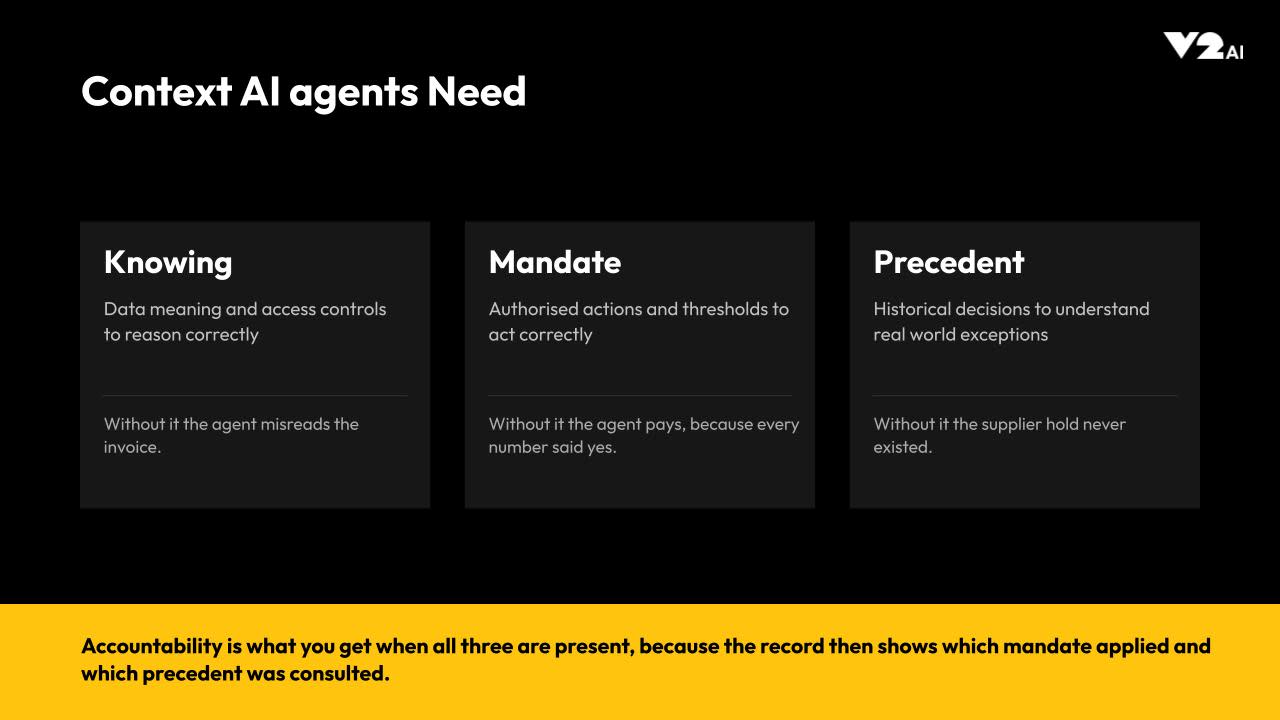
Context is what an employee learns from experience by working inside the organisation. It includes information about business meaning, relationships, and how data is used within the organisation, alongside policy, precedent, authority, and what has changed in the moment.
Knowledge: Understand the Business
Helps the agent answer: what does this data mean, and may I see it?
Semantics is a key aspect of context and typically includes entities, relationships, definitions, metrics, domains and lineage. But an agent about to act needs more than that.
Mandate: Policies and Permissions
Helps the agent answer: Am I authorised to take this action?
An agent may validate a $240,000 invoice against known supplier, purchase order, and budget data, but if the agent's authority limit is $50,000, it cannot release that payment.
Mandate is about policy, identity, authority and the conditions under which an action is permitted. The agent needs to know what policies apply to which decision.
Precedent: Learn From Previous Decisions
Helps the agent answer: What did we decide last time?
Precedent is what was decided before in comparable cases, on what basis, and whether that decision held up. It is the difference between an agent that treats every exception as new and one that knows how the organisation handled the last one. Organisations make decisions every day that are difficult to capture in structured data. People learn over time what is normal and how to handle exceptions. Much of this knowledge is organisational and exists in meeting notes, communications, or, simply, in team experience.
The Enterprise Context Challenge
The challenge is giving agents the context they need to move from understanding the organisation to acting responsibly within it.
People make reliable decisions based on past experience and situational understanding. They have access to the systems, know the relevant people and understand how the organisation operates.
In contrast, every time an agent runs, it starts as a brilliant stranger. The organisation has to make all the context available in a form the agent can evaluate at the point of decision.
Why Today’s Approaches to Context Fall Short
Teams try to introduce context using several different approaches.
Approach | Method | Limitation |
Prompt-based approaches | Teams manually insert context into the agent’s prompt. | Difficult to maintain at scale. Past decision records are lost with each prompt update, making it hard to reconstruct what the agent was told when it made a particular decision. |
Retrieval-based approaches | The agent retrieves policy documents as part of its reasoning process. | Documents can describe a rule but cannot enforce it. They may also fail to establish whether the rule applies to a particular case at the time of decision. |
Policy in model reasoning | Policies and organisational rules are baked into the model’s reasoning. | Policies, authority limits and roles change. Baked-in policies are difficult to revoke or update Increases agent maintenance effort and cost. |
Guardrails around agent output | Guardrails are applied to the agent’s output to prevent certain actions. | Guardrails can stop negative actions, but cannot determine whether an otherwise valid action is one the agent is authorised to take. |
All approaches share a fundamental limitation. They treat context as a payload that can be given to an AI agent in advance.
However, context must be evaluated at the moment of decision, against who is asking and what has happened since the last decision.
The Risk of Self-Reinforcing AI
Another risk arises when organisations start capturing context for agents: an agent's own actions can inadvertently become evidence for future decisions.
When the conditions are missing, an agent may start treating a conditional decision as a standing rule. This creates a negative feedback loop:
The agent acts based on a piece of context
The action becomes part of the record
The record reinforces the original context despite changing circumstances.
Consider a scenario where the agent is told not to make a payment because a specific supplier is on hold. The supplier was placed on hold on a particular date, pending a specific quality review. The hold applied only to certain transactions, and the decision was later reversed. However, unaware of the nuances, the agent always blocks payments to that supplier.
Two guards break the loop. Nothing an agent produced ever counts as evidence for the rule it acted on, and every rule keeps the conditions it was written under, or it is not a rule.
Building the Context Layer for Enterprise AI with Databricks
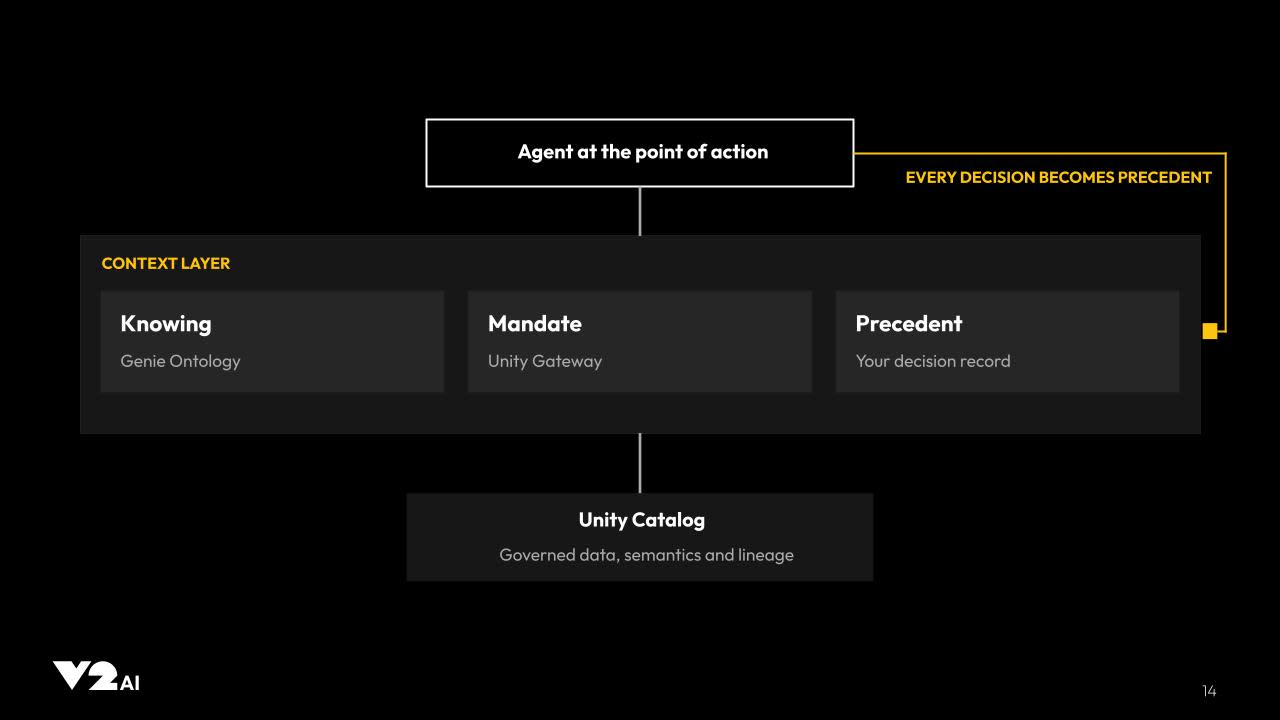
Each of the three kinds of context an agent needs, knowledge, mandate and precedent, maps to a capability that already exists in the Databricks platform.
An enterprise agent needs a governed path from the information it uses to the action it takes. That path has to evaluate context at the moment of decision and capture it with its conditions intact.
Give Agents a Trusted View of the Business
Databricks Unity Catalog provides the governance layer for data tables, metric views, domains, certified definitions and lineage, including who can access what.
Databricks Genie Ontology provides a structured map of what things mean and how they relate to one another. It brings together the semantics organisations have already established with inferred information from the broader data estate.
Enforce What Agents Are Authorised to Do
Databricks Unity Gateway extends governance beyond data and AI assets to the runtime interactions between agents, models, tools and MCP servers.
Unity Catalog is the source of truth. Unity Gateway is the enforcement point.
Instead of simply telling an agent that a policy exists, the policy is evaluated when the agent actually attempts to take an action.
Build Organisational Memory
Databricks Lakebase provides a transactional store so organisations can create a structured record of an organisation’s day-to-day decisions. A decision record can capture:
Acting for: Who was the agent acting on behalf of?
Authority limit: What authority did it have?
Policy version: Which rule applied?
Decision: What action was taken?
Outcome: What happened afterwards?
Conditions: What was true when the decision was made?
Beyond audit trails, the record contains information about which decisions held up and which escalations proved necessary. It becomes organisational memory that accumulates over time and supports improved decision-making by both humans and AI agents.
Final Words
The hard problem is ensuring an AI agent follows organisational policies and past learnings every time it acts.
When agents operate reliably within an organisation, the potential business impact is fewer manual handoffs, faster decisions, more consistent execution and the ability to scale operational capacity without scaling every process linearly with headcount.
None of that comes from a pilot, and pilots don't stall on capability. They stall because nobody can answer what happens when agents go wrong.
Context is the critical step that ensures an agent remains accountable. Accountability allows organisations to move agentic projects from pilot to production with confidence.